4A0-C02 Nokia SRA Composite Exam

Loading demo links...

Showing 10–12 of 20 questions

Question 10 (Nokia Quality of Service)

Which of the following statements are TRUE when discussing self-generated traffic QoS? (Choose two)

Select all that apply, then click Submit answer.

  • In order to mark Layer 2 traffic, sgt-qos will set various ToS bits.

  • DSCP bits can be set per application, per routing instance.

  • The DSCP marking stays nc1 for all applications. Only the internal FC is manipulated across different applications.

  • In order to mark Layer 2 self-generated traffic, network interfaces must be set to dot1Q.

  • The internal forwarding class for self-generated traffic is set once and applied to the base router and all VPRN instances.
Question 11 (Nokia Virtual Private Routed Networks)

Which of the following describes the goal of an Extranet VPRN?

Select an option, then click Submit answer.

  • To reduce the number of VPRN tunnels required.

  • To allow routes to be exchanged between all, or selected, sites of one VPRN, and all, or selected, sites of a second VPRN.

  • To simplify the administration of multiple VPRNs.

  • To allow network access between the headquarter sites of each VPRN service and a shared VPRN service offered by a third party.

Question 12 (Nokia Virtual Private Routed Networks)

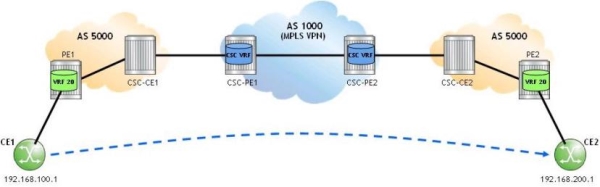
Click the exhibit.

C:\Documents and Settings\David\Desktop\1.jpg

A Carrier Supporting Carrier (CSC) VPRN is configured for a customer carrier who is a BGP/MPLS service provider. If CE1 sends an IP packet to 192.168.200.1, which of the following is FALSE?

Select an option, then click Submit answer.

  • CE1 forwards the data packet to PE1 via the VPRN 20 interface.

  • PE1 pushes two labels on the IP packet: a BGP label and an LDP transport label.

  • CSC-CE1 pops the LDP label and swaps the BGP label.

  • CSC-PE1 pops the BGP label and pushes a VPN label and an MPLS transport label.