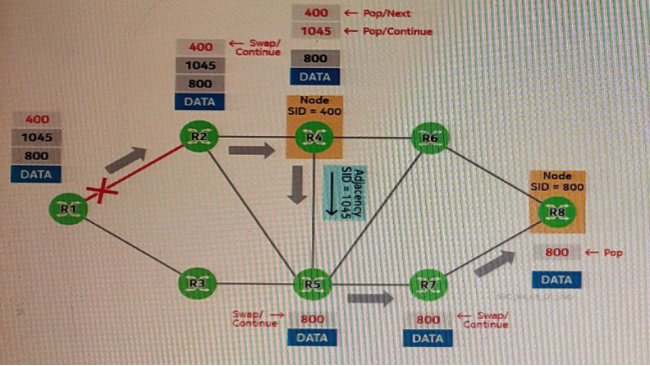
The exhibit presents packets being transmitted inside an LSP's multi-segment primary path going from router R1 to router R8. The LSP also has a standby secondary path, and Seamless-BFD has been enabled on the primary path. The link between routers R1 and R2 fails, and fast re-route (FRR) is triggered. As a result, router R1 forwards the packets to router R3 and adds the proper FRR encapsulation to reach which router?
Select an option, then click Submit answer.
-
○
To reach router R2, which is the LSP's intended next-hop.
-
○
To reach router R5, which is the shortest way to go back to the original path.
-
○
To reach router R4, which is the tail-end of the active segment.
-
○
To reach router R8, which is the tail-end of the LSP.
