DP-420 Designing and Implementing Cloud-Native Applications Using Microsoft Azure Cosmos DB (beta)

Loading demo links...

Showing 7–9 of 10 questions

Question 7 (New Update)

Note: This question is part of a series of questions that present the same scenario. Each question in the series contains a unique solution that might meet the stated goals. Some question sets might have more than one correct solution, while others might not have a correct solution.

After you answer a question in this section, you will NOT be able to return to it. As a result, these questions will not appear in the review screen.

You have a container named container1 in an Azure Cosmos DB Core (SQL) API account.

You need to make the contents of container1 available as reference data for an Azure Stream Analytics job.

Solution: You create an Azure function that uses Azure Cosmos DB Core (SQL) API change feed as a trigger and Azure event hub as the output.

Does this meet the goal?

Select an option, then click Submit answer.

  • Yes

  • No

Question 8 (New Update)

You have a container named container1 in an Azure Cosmos DB for NoSQL account named account1 that is set to the session default consistency level. The average size of an item in container1 is 20 KB.

You have an application named App1 that uses the Azure Cosmos DB SDK and performs a point read on the same set of items in container1 every minute.

You need to minimize the consumption of the request units (RUs) associated to the reads by App1. What should you do?

Select an option, then click Submit answer.

  • In account1, change the default consistency level to bounded staleness.

  • In App1, change the consistency level of read requests to consistent prefix.

  • In account1, provision a dedicated gateway and integrated cache

  • In App1, modify the connection policy settings.

Question 9 (Mixed Questions)

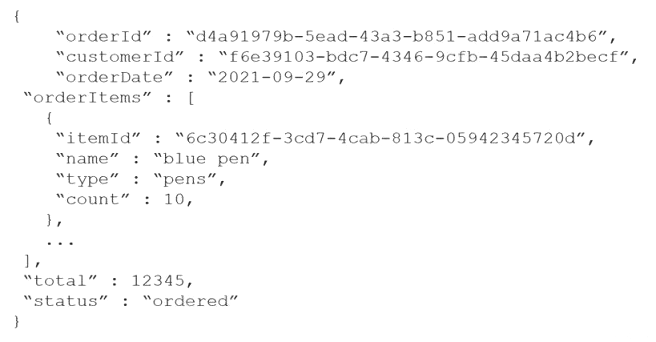
The following is a sample of a document in orders.

The orders container uses customerId as the partition key.

You need to provide a report of the total items ordered per month by item type. The solution must meet the following requirements:

Ensure that the report can run as quickly as possible. Minimize the consumption of request units (RUs).

What should you do?

Select an option, then click Submit answer.

  • Configure the report to query orders by using a SQL query.

  • Configure the report to query a new aggregate container. Populate the aggregates by using the change feed.

  • Configure the report to query orders by using a SQL query through a dedicated gateway.

  • Configure the report to query a new aggregate container. Populate the aggregates by using SQL queries that run daily.