70-767 Implementing a SQL Data Warehouse

Loading demo links...

Showing 7–9 of 10 questions

Question 7

You have a data warehouse that contains a fact table named Table1 and a Product table named Dim1. Dim1 is configured as shown in the following table.
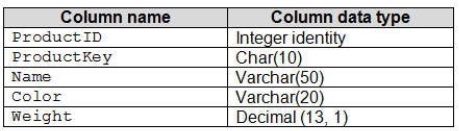
You are adding a second OLTP system to the data warehouse as a new fact table named Table2. The Product table of the OLTP system is configured as shown in the following table
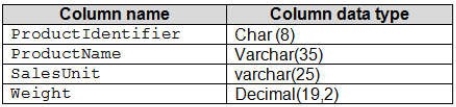
You need to modify Dim1 to ensure that the table can be used for both fact tables.

Which two actions should you perform? Each correct answer presents part of the solution.

NOTE: Each correct selection is worth one point.

Select all that apply, then click Submit answer.

  • Modify the data type of the Weight column in Dim1 to decimal (19, 2).

  • Add the SalesUnit column to Dim1.

  • Modify the data type of the Name column in Dim1 to varchar (85).

  • Drop the ProductKey column from Dim1 and replace the column with the ProductIdentifier column.

  • Drop the Color column from Dim1.

  • Modify the data type of the ProductKey column in Dim1 to char (18).
Question 8

Note: This question is part of a series of questions that present the same scenario. Each question in the series contains a unique solution that might meet the stated goals. Some question sets might have more than one correct solution, while others might not have a correct solution.

After you answer a question in this section, you will NOT be able to return to it. As a result, these questions will not appear in the review screen.

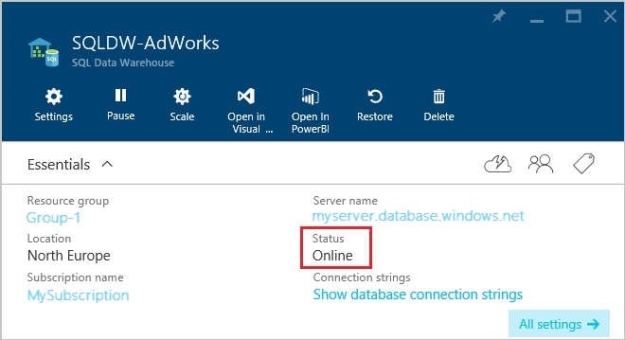
You have a Microsoft Azure SQL Data Warehouse instance that must be available six months a day for reporting.

You need to pause the compute resources when the instance is not being used.

Solution: You use the Azure portal.

Does the solution meet the goal?

Select an option, then click Submit answer.

  • Yes

  • No

Question 9

Note: This question is part of a series of questions that use the same scenario. For your convenience, the scenario is repeated in each question. Each question presents a different goal and answer choices, but the text of the scenario is exactly the same in each question in this series.

You have a Microsoft SQL Server data warehouse instance that supports several client applications.

The data warehouse includes the following tables: Dimension.SalesTerritory, Dimension.Customer, Dimension.Date, Fact.Ticket, and Fact.Order. The Dimension.SalesTerritory and Dimension.Customer tables are frequently updated. The Fact.Order table is optimized for weekly reporting, but the company wants to change it to daily. The Fact.Order table is loaded by using an ETL process. Indexes have been added to the table over time, but the presence of these indexes slows data loading.

All data in the data warehouse is stored on a shared SAN. All tables are in a database named DB1. You have a second database named DB2 that contains copies of production data for a development environment. The data warehouse has grown and the cost of storage has increased. Data older than one year is accessed infrequently and is considered historical.

You have the following requirements:

Implement table partitioning to improve the manageability of the data warehouse and to avoid the need to repopulate all transactional data each night. Use a partitioning strategy that is as granular as possible. Partition the Fact.Order table and retain a total of seven years of data.

Partition the Fact.Ticket table and retain seven years of data. At the end of each month, the partition structure must apply a sliding window strategy to ensure that a new partition is available for the upcoming month, and that the oldest month of data is archived and removed.

Optimize data loading for the Dimension.SalesTerritory, Dimension.Customer, and Dimension.Date tables.

Incrementally load all tables in the database and ensure that all incremental changes are processed.

Maximize the performance during the data loading process for the Fact.Order partition.

Ensure that historical data remains online and available for querying.

Reduce ongoing storage costs while maintaining query performance for current data.

You are not permitted to make changes to the client applications.

You need to optimize the storage for the data warehouse.

What change should you make?

Select an option, then click Submit answer.

  • Partition the Fact.Order table, and move historical data to new filegroups on lower-cost storage.

  • Create new tables on lower-cost storage, move the historical data to the new tables, and then shrink the database.

  • Remove the historical data from the database to leave available space for new data.

  • Move historical data to new tables on lower-cost storage.

  • Implement row compression for the Fact.Order table.

  • Move the index for the Fact.Order table to lower-cost storage.