HPE6-A80 Aruba Certified Design Expert Written Exam

Loading demo links...

Showing 4–6 of 9 questions

Question 4

A company already has an Aruba wireless network The network currently consists of:

* oneMM-HW-1k

* two 7210 MCs in the network core

* two 721GMCsintheDMZ

* 200 AP-515S in Building 1 and Building 5

100 AP-515S each In Building 2r Building 3, and Building 4

The customer now wants to assess if it needs local Mobility controllers (MC) for any buildings:

- Building 1 is the main office building for the campus. It supports the highest number of

APs. It connects to the

network core without an aggregation layer.

* Building 2 is further away from the Building i. and no roaming is provided between it andthe other buildings its

access layer connects to the network cone with a pair of Aruba CX 6300M aggregation switches.

* Building 3 is further away from the other buildings, it connects to the network core withoutan aggregation layer.

The Guest SSID traffic should be tunnelled to the DMZ controllers

’ Building 4 has its own local datacenter and Internet connection. The company would like it to be able to operate

completely autonomously if its aggregation layer loses connectivity with the core.

* Building 5 is further away from the other buildings, it connects to the network core withoutan aggregation layer.

This building has been assigned to a partner that would like to manage a dedicated SS1D using the shared AP infrastructure.

In which two buildings should the network architect plan local mobility controllers (MCs)?

(Select two)

Select all that apply, then click Submit answer.

  • Building 1

  • Building 4

  • Building 5

  • Building 3

  • Building 2

Question 5

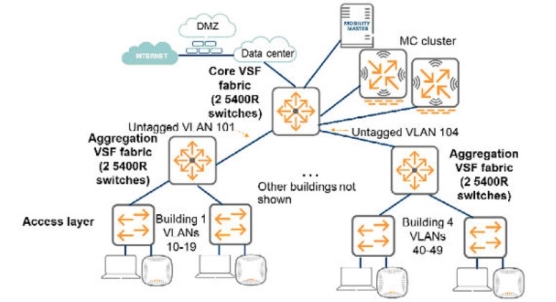
Refer to the exhibit.

A customer has the wined infrastructure shown in the exhibit. The customer is in the process of expanding their wireless services They will now add a new wireless solution, with mobility controllers (MCs) connected as shown. The new wireless solution will support a total of 450 APs and about 26,000 wireless devices. It must provide seamless roaming across the entire campus.

After the new deployment, both wired and wireless devices experience IP connectivity issues.

Which change to the existinginfrastructureshould the architect recommend to support all of the customer requirements?

Select an option, then click Submit answer.

  • The wired VLANS should be combined into a single VLAN and n6 subnet

  • The core switches should be replaced with switches that have larger ARP tables.

  • The MCs should be moved to the aggregation layer, and more MCs added

  • The core and aggregation switches should disable Virtual Switching Framework (VSF).


Question 6

A retailer currently has two redundant ClearPass C2000 0L36O Gen9 hardware appliances and two perpetual 1K Access licenses. The customer uses ClearPass to authenticate employee wireless devices and other corporate wireless devices. ClearPass togs indicate that, peak license usage is currently 1900.

The customer now wants to add a guest access solution. Guests will connect to an open SSiD and be redirected to a portal which they can use to self-register and log in. The customer anticipates that up to f 550 guest devices will connect at the same time.

The customer requires the most cost-effective solution that will meet the requirements.

What should the network architect recommend for this solution?

Select an option, then click Submit answer.

  • IK + 500 Access licenses: IK + 500 Guest licenses

  • 1K + 500 Access licenses; Two 1K Onboard licenses

  • 1K + 500 Access licenses

  • Two 1K Guest licenses