HPE6-A45 Implementing Aruba Campus Switching solutions

Loading demo links...

Showing 1–3 of 10 questions

Question 1

A network administrator needs to set up an AOS-Switch to use port-based tunneled node for connected devices. However, the administrator wants the switch to forward traffic without tunneling if it cannot reach a tunneled-node server.

What should the administrator do?

Select an option, then click Submit answer.

  • Apply the tunneled-node profile to ports, and set the local-switching-fallback option.

  • Make sure that the switch has an IP address on the untagged VLAN assigned to the ports.

  • Configure a local switching profile on the Mobility Controller that acts as tunneled-node server.

  • Set the switch to role-based tunneled node, and make sure it uses the default initial user role.
Question 2

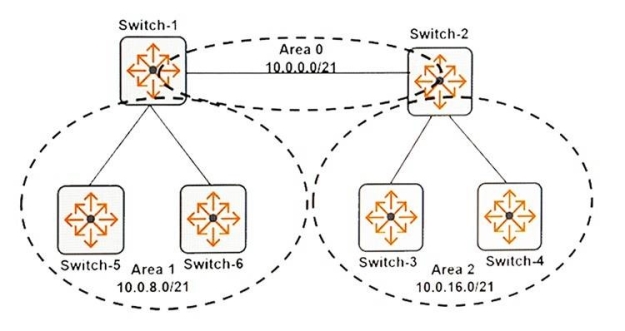
Refer to the exhibit.

The network administrator wants to summarize routes as much as possible in between areas. What is the correct range to specify for the router OSPF Area 2 command on Switch-2?

Select an option, then click Submit answer.

  • 10.0.0.0/20

  • 10.0.0.0/21

  • 10.0.8.0/21

  • 10.0.16.0/21

Question 3

Refer to the exhibit.

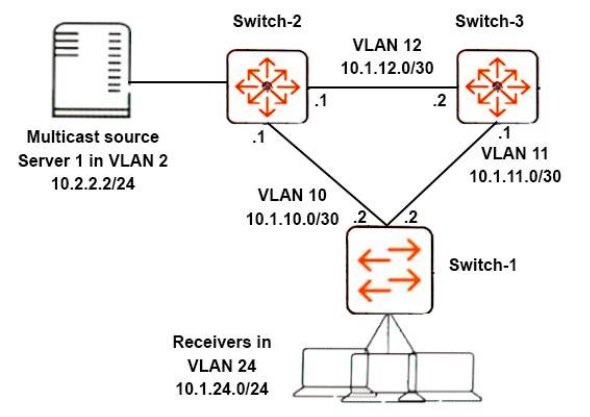
Network administrators set up PIM-DM to route multicast traffic from Server 1 to clients in VLAN 24. The multicasts are not active now, but the administrators want to determine which path the multicasts will take.

What should the administrators check to help them calculate this path?

Select an option, then click Submit answer.

  • If Switch-2 or Switch-3 has the highest IP address on a VLAN that runs PIM-DM.

  • If Switch-2 or Switch-3 is listed as an RP in the Switch-1 RP set

  • What the next hop is for the unicast route that Switch-1 uses to reach 10.2.2.2

  • If the Switch-2 DR priority on VLAN 10 is higher than the Switch-3 DR priority on VLAN 11