Professional-Data-Engineer Professional Data Engineer on Google Cloud Platform

Loading demo links...

Showing 7–9 of 10 questions

Question 7

Your company is performing data preprocessing for a learning algorithm in Google Cloud Dataflow. Numerous data logs are being are being generated during this step, and the team wants to analyze them. Due to the dynamic nature of the campaign, the data is growing exponentially every hour.

The data scientists have written the following code to read the data for a new key features in the logs.
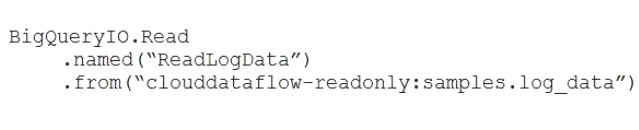
You want to improve the performance of this data read. What should you do?

Select an option, then click Submit answer.

  • Specify the TableReference object in the code.

  • Use .fromQuery operation to read specific fields from the table.

  • Use of both the Google BigQuery TableSchema and TableFieldSchema classes.

  • Call a transform that returns TableRow objects, where each element in the PCollection represents a single row in the table.

Question 8

Your company’s on-premises Apache Hadoop servers are approaching end-of-life, and IT has decided to migrate the cluster to Google Cloud Dataproc. A like-for-like migration of the cluster would require 50 TB of Google Persistent Disk per node. The CIO is concerned about the cost of using that much block storage. You want to minimize the storage cost of the migration. What should you do?

Select an option, then click Submit answer.

  • Put the data into Google Cloud Storage.

  • Use preemptible virtual machines (VMs) for the Cloud Dataproc cluster.

  • Tune the Cloud Dataproc cluster so that there is just enough disk for all data.

  • Migrate some of the cold data into Google Cloud Storage, and keep only the hot data in Persistent Disk.

Question 9

Your infrastructure includes a set of YouTube channels. You have been tasked with creating a process for sending the YouTube channel data to Google Cloud for analysis. You want to design a solution that allows your world-wide marketing teams to perform ANSI SQL and other types of analysis on up-to-date YouTube channels log data. How should you set up the log data transfer into Google Cloud?

Select an option, then click Submit answer.

  • Use Storage Transfer Service to transfer the offsite backup files to a Cloud Storage Multi-Regional storage bucket as a final destination.

  • Use Storage Transfer Service to transfer the offsite backup files to a Cloud Storage Regional bucket as a final destination.

  • Use BigQuery Data Transfer Service to transfer the offsite backup files to a Cloud Storage Multi-Regional storage bucket as a final destination.

  • Use BigQuery Data Transfer Service to transfer the offsite backup files to a Cloud Storage Regional storage bucket as a final destination.