NSE8_811 Fortinet NSE 8 Written Exam

Loading demo links...

Showing 1–3 of 10 questions

Question 1

Refer to the exhibit.
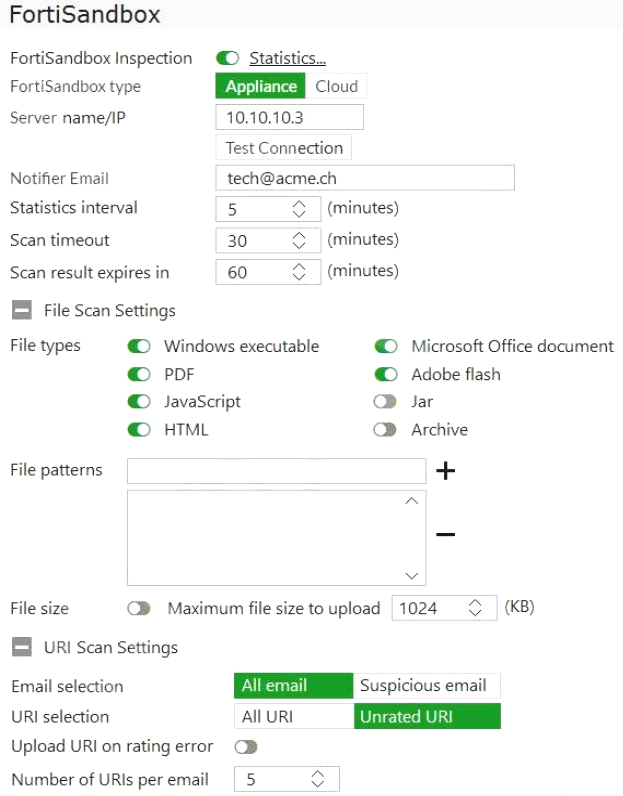
You have installed a FortiSandbox and configured it in your FortiMail.

Referring to the exhibit, which two statements are correct? (Choose two.)

Select all that apply, then click Submit answer.

  • If FortiMail is not able to obtain the results from the FortiGuard queries, URIs will not be checked by the FortiSandbox.

  • FortiMail will cache the results for 30 minutes

  • If the FortiSandbox with IP 10.10.10.3 is not available, the e-mail will be checked by the FortiCloud Sandbox.

  • FortiMail will wait up to 30 minutes to obtain the scan results.
Question 2

Refer to the exhibit.

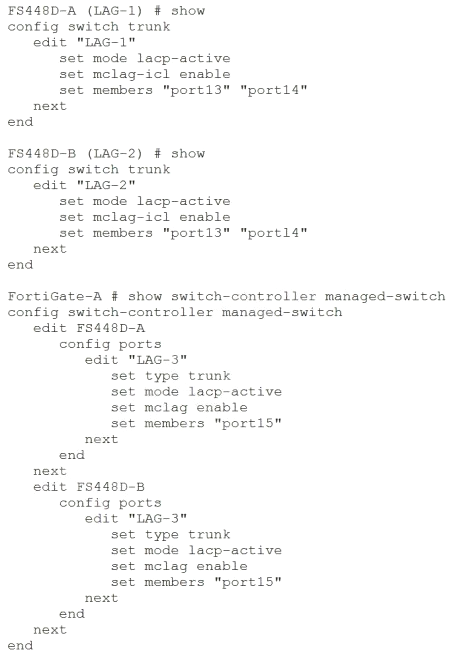
Given the configuration shown in the exhibit, which two statements are true? (Choose two.)

Select all that apply, then click Submit answer.

  • LAG-3 on switches on FS448D-A and FS448D-B may be connected to a single 802.3ad trunk on another device.

  • LAG-1 and LAG-2 should be connected to a 4-port single 802.3ad trunk on another device.

  • port13 and port14 on FS448D-A should be connected to port13 and port14 on FS448D-B.

  • LAG-1 and LAG-2 should be connected to a single 4-port 802.3ad interface on the FortiGate-A.

Question 3

Refer to the exhibit.

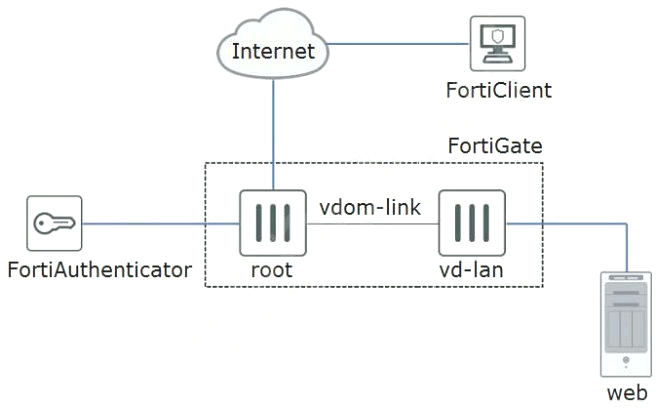
The exhibit shows a topology where a FortiGate is split into two VDOMs, root and vd-lan. The root VDOM provides external SSL-VPN access, where the users are authenticated by a FortiAuthenticator. The vd-lan VDOM provides internal access to a Web server.

For the remote users to access the internal Web server, there are a few requirements as follows:

• All traffic must come from the SSL-VPN.

• The vd-lan VDOM only allows authenticated traffic to the Web server.

• Users must only authenticate once, using the SSL-VPN portal.

• SSL-VPN uses RADIUS-based authentication.

Given these requirements and the topology shown in the exhibit, which two statements are true? (Choose two.)

Select all that apply, then click Submit answer.

  • vd-lan connects to FortiAuthenticator as a regular FSSO client.

  • root is configured for FSSO while vd-lan is configured for RSSO.

  • root sends "RADIUS Accounting Messages" to FortiAuthenticator

  • vd-lan receives authentication messages from root using FSSO.