NSE4_FGT-7.0 Fortinet NSE 4 - FortiOS 7.0

Loading demo links...

Showing 7–9 of 10 questions

Question 7

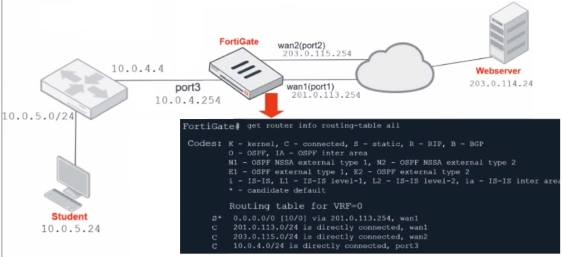
Refer to the exhibit.
C:\Users\Admin\Desktop\Data\Odt data\Untitled.jpg

Which contains a network diagram and routing table output.

The Student is unable to access Webserver.

What is the cause of the problem and what is the solution for the problem?


Select an option, then click Submit answer.

  • The first packet sent from Student failed the RPF check.
    This issue can be resolved by adding a static route to 10.0.4.0/24 through wan1.
     

  • The first reply packet for Student failed the RPF check.
    This issue can be resolved by adding a static route to 10.0.4.0/24 through wan1.
     

  • The first reply packet for Student failed the RPF check.
    This issue can be resolved by adding a static route to 203.0.114.24/32 through port3.
     

  • The first packet sent from Student failed the RPF check.
    This issue can be resolved by adding a static route to 203.0.114.24/32 through port3.
Question 8

Refer to the exhibits.

C:\Users\Admin\Desktop\Data\Odt data\Untitled.jpg

C:\Users\Admin\Desktop\Data\Odt data\Untitled.jpg

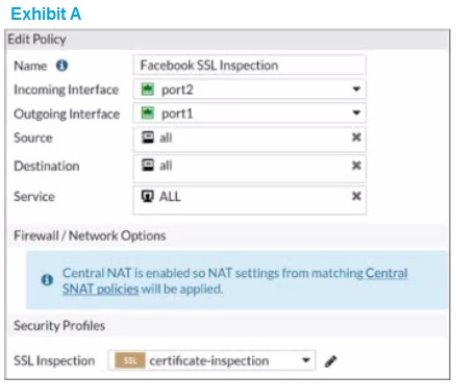
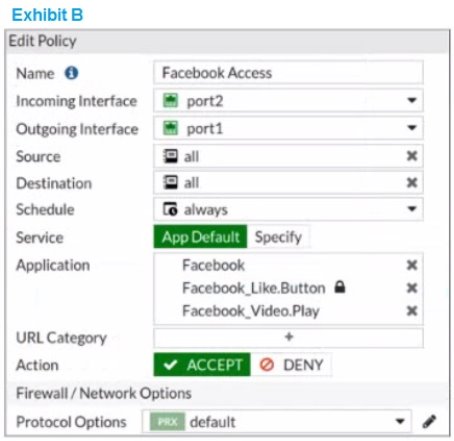
The exhibits show the SSL and authentication policy (Exhibit A) and the security policy (Exhibit B) tor Facebook.

Users are given access to the Facebook web application. They can play video content hosted on Facebook but they are unable to leave reactions on videos or other types of posts.

Which part of the policy configuration must you change to resolve the issue?

Select an option, then click Submit answer.

  • The SSL inspection needs to be a deep content inspection.

  • Force access to Facebook using the HTTP service.

  • Additional application signatures are required to add to the security policy.

  • Add Facebook in the URL category in the security policy.

Question 9

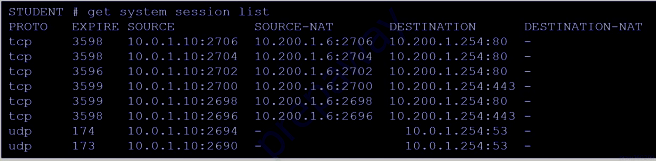
Refer to the exhibit, which contains a session list output.

Based on the information shown in the exhibit, which statement is true?

Select an option, then click Submit answer.

  • One-to-one NAT IP pool is used in the firewall policy.

  • Destination NAT is disabled in the firewall policy.

  • Port block allocation IP pool is used in the firewall policy.

  • Overload NAT IP pool is used in the firewall policy.