400-101 CCIE Routing and Switching Written

Loading demo links...

Showing 10–12 of 20 questions

Question 10 (Evolving Technologies)

Which two statements about the passive-interface command issued under EIGRP are true? (Choose two.)

Select all that apply, then click Submit answer.

  • It allows incoming routing updates to be received but disables outgoing routing updates.

  • It disables processing of incoming hello messages.

  • It configures the interface to use unicast messages to establish EIGRP neighbor relationships.

  • If it is enabled globally under EIGRP on the device, it can be disabled for individual interfaces to allow those interfaces to remain active.

  • It configures the device to advertise only connected interfaces to neighbors with EIGRP.
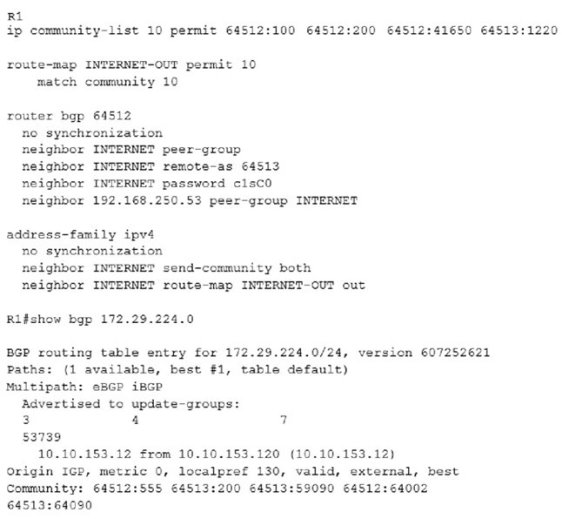
Question 11 (Evolving Technologies)

Refer to the exhibit. Which two actions can you take to allow the network 172.29.224.0/24 to be reachable from peer 192.168.250.53? (Choose two.)

Select all that apply, then click Submit answer.

  • Modify the outbound route map to permit all additional routes.

  • Modify the inbound route map to permit all additional routes.

  • Configure additional address families to peering 192.168.250.53.

  • Modify the community list to match community 64513:64090 attached to 172.29.224.0/24

  • Configure soft reconfiguration to peering 192.168.250.53

Question 12 (Evolving Technologies)

Which option describes the effect of the command ip route vrf DMZ 192.168.0.0 255.255.0.0 172.16.5.5 global?

Select an option, then click Submit answer.

  • It creates a static route in the VRF DMZ for 192.168.0.0 255.255.0.0, and the nexthop is in the global routing table.

  • It creates a static route in the global routing table for 192.168.0.0 255.255.0.0, and the next hop is in the VRF DMZ.

  • It creates a static route in the VRF DMZ for 192.168.0.0 255.255.0.0, and the next hop is in the VRF DMZ.

  • It creates a static route in the global routing table for 192.168.0.0 255.255.0.0, and the next hop is in the global routing table.

  • It creates a static default route in the VRF DMZ, and the next hop is in the global routing table.