300-135 CCNP Troubleshooting and Maintaining Cisco IP Networks (TSHOOT v2.0)

Loading demo links...

Showing 7–9 of 10 questions

Question 7 (Mixed Questions)

Scenario:

A customer network engineer has edited their OSPF network configuration and now your customer is experiencing network issues. They have contacted you to resolve the issues and return the network to full functionality.
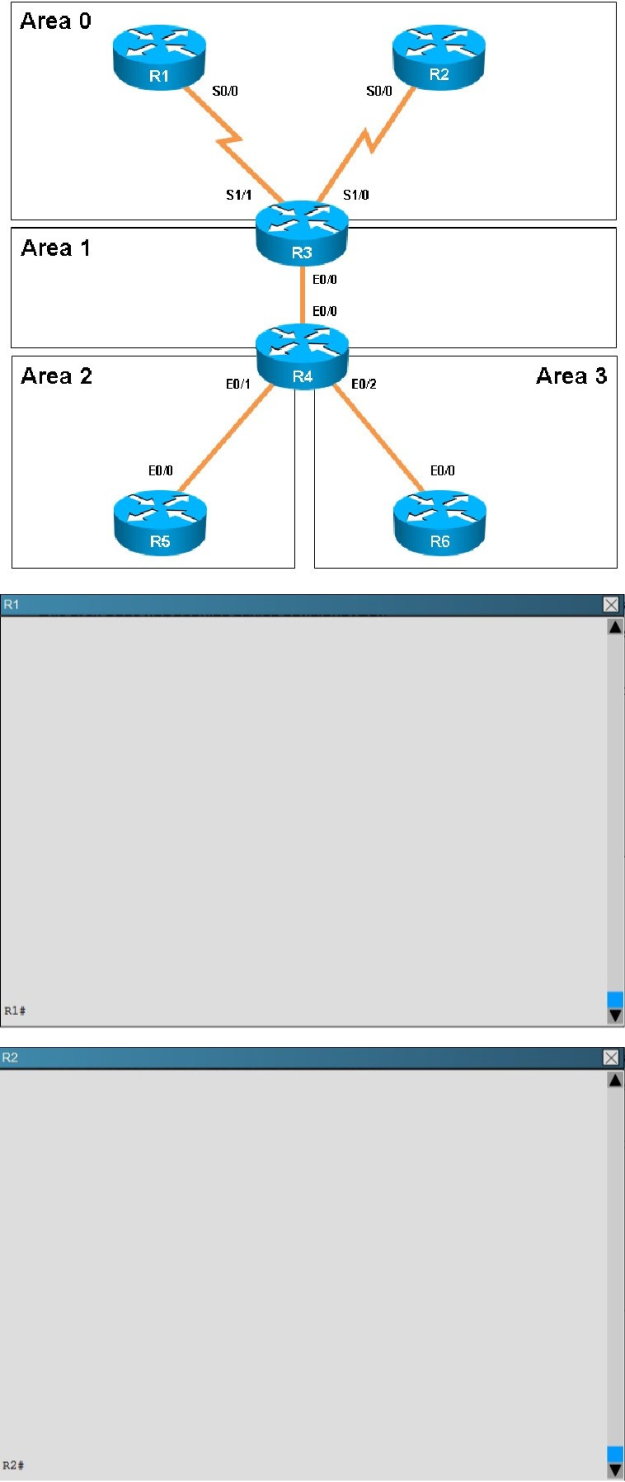
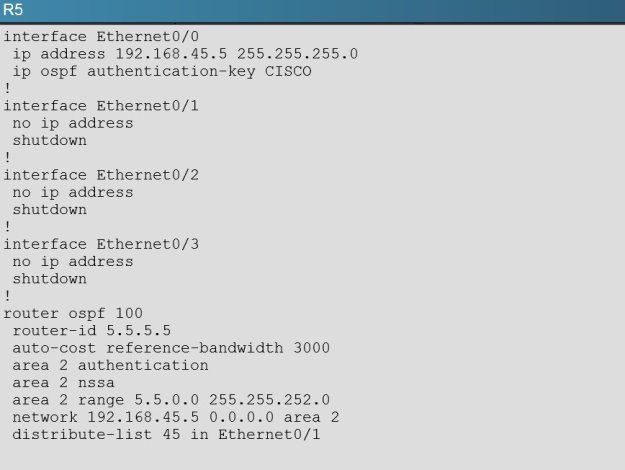
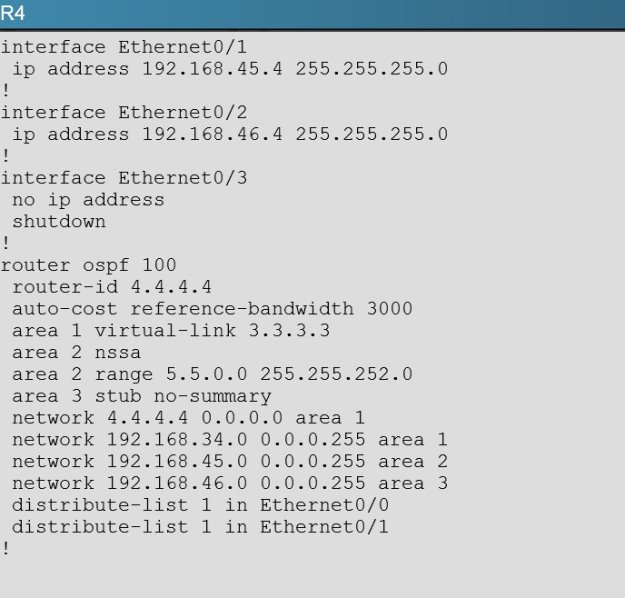
After resolving the issues between R3 and R4. Area 2 is still experiencing routing issues. Based on the current router configurations, what needs to be resolved for routes to the networks behind R5 to be seen in the company intranet?

Select an option, then click Submit answer.

  • Configure R4 and R5 to use MD5 authentication on the Ethernet interfaces that connect to the common subnet.

  • Configure Area 1 in both R4 and R5 to use MD5 authentication.

  • Add ip ospf authentication-key 7 BEST to the R4 Ethernet interface that connects to R5 and ip ospf authentication-key 7 BEST to R5 Ethernet interface that connects to R4.

  • Add ip ospf authentication-key CISCO to R4 Ethernet 0/1 and add area 2 authentication to the R4 OSPF routing process.
Question 8 (Case Study 14)

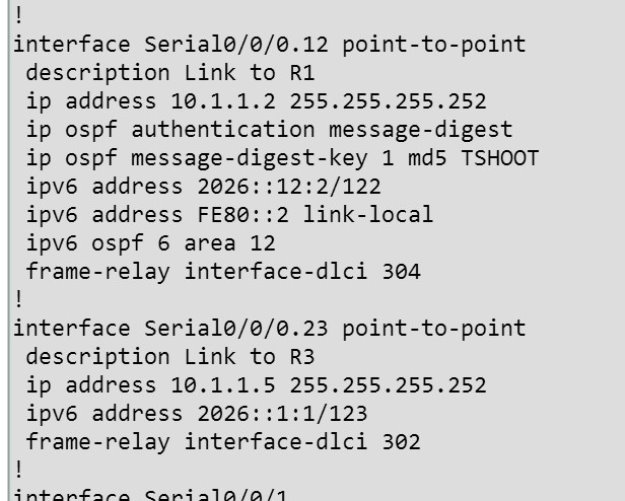
The implementation group has been using the test bed to do an IPv6 'proof-of-concept1. After several changes to the network addressing and routing schemes, a trouble ticket has been opened indicating that the loopback address on R1 (2026::111:1) is not able to ping the loopback address on DSW2 (2026::102:1).

Use the supported commands to isolate the cause of this fault and answer the following question.

What is the solution to the fault condition?

Select an option, then click Submit answer.

  • Under the interface SerialO/0/0.23 configuration enter the ipv6 ospf 6 area 0 command.

  • Under the interface SerialO/0/0.12 configuration enter the ipv6 ospf 6 area 12 command.

  • Under ipv6 router ospf 6 configuration enter the network 2026::1:/122 area 0 command.

  • Under ipv6 router ospf 6 configuration enter the no passive-interface default command

Question 9 (Mixed Questions)

A network contains a remote tunnel interface and firewalls in the network path of each router. An attempt to ping the IP address of the remote tunnel interface fails. Which connections should be allowed through the firewalls?

Select an option, then click Submit answer.

  • IP protocol 47

  • TCP port 47

  • TCP port 1723

  • IP protocol 50