CS3 Strategic Case Study Exam 2021

Loading demo links...

Showing 7–9 of 10 questions

Question 7 (Slide Company)

CORRECT TEXT

From: Martin Wills, Head Geologist

To: William Seaton, Director of Finance

Subject: Reserves

Hi William,

I have reviewed the situation with respect to our “probable” or “2P” reserves, as disclosed in our latest annual report. I am sorry to say that we have to downgrade our figures with respect to reserves. I am recommending that all extraction activities cease for the foreseeable future on the North Atlantic and South Atlantic fields and that the proved reserves be downgraded from proved to probable.

I have to stress that this is not attributable to any past error on the part of the geologists. The world oil price has been depressed and the discovery of large deposits of shale oil in the USA suggests that the oil price will not recover for some time. That means that some oil wells that were commercially viable this time last year are no longer worth processing.

The oil remains under the rock and I have no doubt that we will restore operations in the long term.

We are by no means the only oil company to have been forced to take this action.

The one piece of good news is that the financial statements for the year ended 31 December 2014 have already been published. My understanding is that we do not have to withdraw them, so unless you put an advertisement in the press, we can carry on quietly trying to sort this mess out.

I have my best people working on ways to extract oil from our wells more efficiently, so we may be able to increase production over the next year or so.

Martin

Answer is in the explanation below.
Question 8 (Case Study Wodd)

CORRECT TEXT

Two months have passed since the threatened disruption of the building work on the biomass power station. The threat has been resolved and work is again under way on the development.

You have received the following email from Peter Sorchi, CEO:

From: Peter Sorchi, Chief Executive Officer

To: Senior Finance Manager

Subject: Wildlife survey

Hi,

I tried to obtain some trustworthy advice from your boss this afternoon, but have come away feeling quite unsure that we are on the same wavelength.

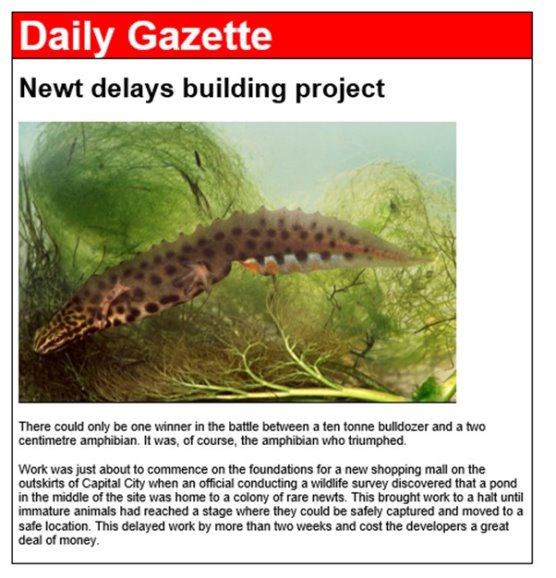
As you know, the law in Marland is very clear concerning the protection of rare species of wildlife. Before building work commences on our new power station the Government will send a survey team to check for the presence of protected species. The attached article shows how sensitive an issue this can be.

As part of our corporate social responsibility, every one of Wodd’s forestry teams has a small team of wildlife officers, whose job is to survey the forest and to identify all natural habitats. Trees can grow undisturbed for many years in a commercial forest before they are harvested and so natural habitats can become well established. Our wildlife surveys enable us to limit the harm done when trees are felled.

One of Wodd’s wildlife officers in the North Forest has submitted a report on the sighting of a rare species of bat in the area that will be cleared for the power station. The report states that these creatures tend to be difficult to observe because they only come out very late at night and tend to roost in dense forest. This could, potentially, delay the start of work for six months while the bats are captured and relocated. Relocating the bats will also be expensive.

The Finance Director’s advice was to ask the wildlife officer to change the report, stating that the original version was submitted in error and that the sighting occurred in a completely different part of the forest, well away from the planned construction site. There is only a small possibility that the Government inspectors will find the bats during their own inspection. In the event that they do then Wodd can claim that it was unaware of the bats’ presence.

This whole exchange raises a number of issues for me.

Should we spend shareholder money on protecting wildlife in our forests?

What are the implications for our internal control system of the Finance Director asking for this report to be changed?

What are the difficulties in motivating our wildlife officers and how might we overcome these?

The Chairman is always complaining about how the executive directors are too aggressive when it comes to making a profit. How might I address that concern?

I would appreciate your response on each of the above issues.

Peter

Answer is in the explanation below.

Question 9 (Case Study Wodd)

CORRECT TEXT

The formal merger with Darrell has been negotiated and the legal formalities have been completed. The two company management teams are working on the integration of the two businesses.

You receive an email from Peter Sorchi, the Chief Executive of the merged company:

From: Peter Sorchi, Chief Executive Officer

To: Senior Finance Manager

Subject: Integration of IT and treasury

Hi,

I need you to advise me on a couple of matters. The attached press clipping shows how sensitive this is.

We need to integrate the IT and treasury functions of the former Wodd and Darrell. I thought that it would be a simple matter of identifying the common ground and slimming down both companies’ departments to cover the new entity, but I have the heads of both IT and treasury from each company arguing that their approaches are better for the merged group and that they should take the lead.

Wodd’s Treasurer claims to be an expert in natural hedging of currency risks and Darrell’s argues that her department was highly successful because it makes excellent use of derivatives for hedging. Both agree only on the fact that they cannot work together. I am afraid that I have to agree with them on that and the Board will have the difficult decision of choosing between them.

I have the opposite problem with the IT function. The two Heads of IT are excited to be able to combine their databases and to develop their respective interests in Big Data. They claim that we should retain all of the professional staff in both departments and possibly even expand the merged IT Department beyond that. Given the rationalisation in all of our other functions, I do not think that we can agree to that, but I would hate to throw away a worthwhile opportunity.

Please give me your thoughts on the following:

What approach to hedging is more likely to meet our needs: natural hedging or heavy use of derivatives?

Ignoring hedging, what other factors should we consider in deciding between the two treasurers?

Are the two heads of IT likely to be correct in arguing that we need to retain all existing IT staff in order to exploit synergies in data, particularly opportunities to leverage Big Data?

What would the challenges be in motivating them to reduce their joint staffing levels and how might we deal with these?

Peter

Answer is in the explanation below.