CIMAPRO15-P01-X1-ENG P1 Management Accounting

Loading demo links...

Showing 7–9 of 10 questions

Question 7

TP makes wedding cakes that are sold to specialist retail outlets which decorate the cakes according to the customers’ specific requirements. The standard cost per unit of its most popular cake is as follows:
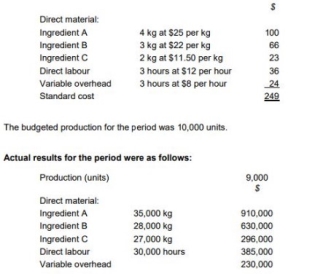
The general market prices at the time of purchase for Ingredient A and Ingredient B were $23 per kg and $20 per kg respectively. TP operates a JIT purchasing system for ingredients and a JIT production system; therefore, there was no inventory during the period.

What was the material yield variance?

Select an option, then click Submit answer.

  • The material yield variance was $98 500 A

  • The material yield variance was $175 500 A

  • The material yield variance was $155 000 A

  • The material yield variance was $175 000 A

  • The material yield variance was $155 500 A
Question 8

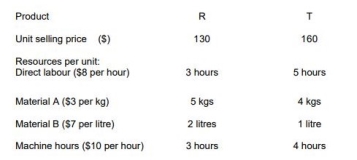
RT produces two products from different quantities of the same resources using a just-in-time (JIT) production system. The selling price and resource requirements of each of the products are shown below:

Market research shows that the maximum demand for products R and T during June 2010 is 500 units and 800 units respectively. This does not include an order that RT has agreed with a commercial customer for the supply of 250 units of R and 350 units of T at selling prices of $100 and $135 per unit respectively. Although the customer will accept part of the order, failure by RT to deliver the order in full by the end of June will cause RT to incur a $10,000 financial penalty. At a recent meeting of the purchasing and production managers to discuss the production plans of RT for June, the following resource restrictions for June were identified:

Direct labour hours 7,500 hours

Material A 8,500 kgs

Material B 3,000 litres

Machine hours 7,500 hours

(Refer to previous 2 questions.)

You have now presented your optimum production plan to the purchasing and production managers of RT. During your presentation it became clear that the predicted resource restrictions were rather optimistic. In fact, the managers agreed that the availability of all of the resources could be as much as 10% lower than their original predictions.

Assuming that RT completes the order with the commercial customer, and using linear programming, show the optimum production plan for RT for June 2010 on the basis that the availability of all resources is 10% lower than originally predicted.

Select an option, then click Submit answer.

  • The optimal plan is to produce 550 units of Product R and 650 units of product T in addition to the contract.

  • The optimal plan is to produce 520 units of Product R and 620 units of product T in addition to the contract.

  • The optimal plan is to produce 510 units of Product R and 720 units of product T in addition to the contract.

  • The optimal plan is to produce 560 units of Product R and 670 units of product T in addition to the contract.

  • The optimal plan is to produce 450 units of Product R and 690 units of product T in addition to the contract.

  • The optimal plan is to produce 500 units of Product R and 550 units of product T in addition to the contract.

Question 9

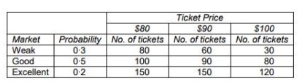
RS is a travel company providing daily tours of a major European capital city. The market is highly competitive and RS has commissioned some market research to help with the pricing decision for a new tour. The research identified the probability of three possible market conditions and the number of tickets that would be sold each day at three different price levels.

Demonstrate, using a decision tree and based on expected value, which ticket price RS should choose.

Select an option, then click Submit answer.

  • RS should charge a ticket price of $70.

  • RS should charge a ticket price of $80.

  • RS should charge a ticket price of $90.

  • RS should charge a ticket price of $100.

  • RS should charge a ticket price of $75