DBS-C01 AWS Certified Database - Specialty

Loading demo links...

Showing 1–3 of 15 questions

Question 1

An ecommerce company is migrating its core application database to Amazon Aurora MySQL. The company is currently performing online transaction processing (OLTP) stress testing with concurrent database sessions. During the first round of tests, a database specialist noticed slow performance for some specific write operations.

Reviewing Amazon CloudWatch metrics for the Aurora DB cluster showed 90% CPU utilization.

Which steps should the database specialist take to MOST effectively identify the root cause of high CPU utilization and slow performance? (Choose two.)

Select all that apply, then click Submit answer.

  • Enable Enhanced Monitoring at less than 30 seconds of granularity to review the operating system metrics before the next round of tests.

  • Review the VolumeBytesUsed metric in CloudWatch to see if there is a spike in write I/O.

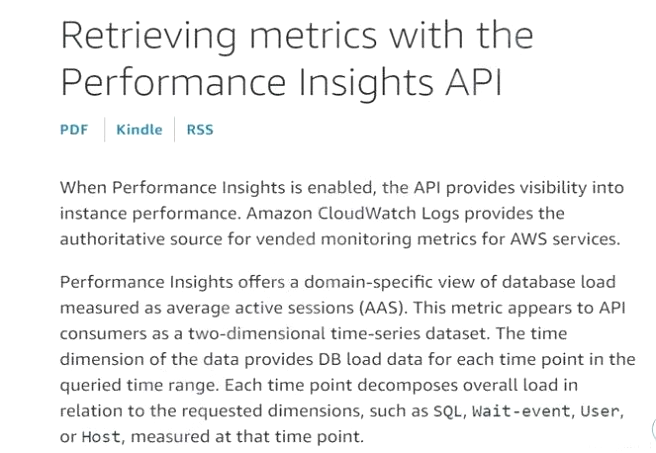
  • Review Amazon RDS Performance Insights to identify the top SQL statements and wait events.

  • Review Amazon RDS API calls in AWS CloudTrail to identify long-running queries.

  • Enable Advance Auditing to log QUERY events in Amazon CloudWatch before the next round of tests.
Question 2

A corporation intends to migrate a 500-GB Oracle database to Amazon Aurora PostgreSQL utilizing the AWS Schema Conversion Tool (AWS SCT) and AWS Data Management Service (AWS DMS). The database does not have any stored procedures, but does contain several huge or partitioned tables. Because the program is vital to the company, it is preferable to migrate with little downtime.

Which measures should a database professional perform in combination to expedite the transfer process? (Select three.)

Select all that apply, then click Submit answer.

  • Use the AWS SCT data extraction agent to migrate the schema from Oracle to Aurora PostgreSQL.

  • For the large tables, change the setting for the maximum number of tables to load in parallel and perform a full load using AWS DMS.

  • For the large tables, create a table settings rule with a parallel load option in AWS DMS, then perform a full load using DMS.

  • Use AWS DMS to set up change data capture (CDC) for continuous replication until the cutover date.

  • Use AWS SCT to convert the schema from Oracle to Aurora PostgreSQL.

  • Use AWS DMS to convert the schema from Oracle to Aurora PostgreSQL and for continuous replication.

Question 3

A company has an AWS CloudFormation stack that defines an Amazon RDS DB instance. The company accidentally deletes the stack and loses recent data from the DB instance. A database specialist must change the CloudFormation template for the RDS resource to reduce the chance of accidental data loss from the DB instance in the future.

Which combination of actions should the database specialist take to meet this requirement? (Choose three.)

Select all that apply, then click Submit answer.

  • Set the DeletionProtection property to True.

  • Set the MultiAZ property to True.

  • Set the TerminationProtection property to True.

  • Set the DeleteAutomatedBackups property to False.

  • Set the DeletionPolicy attribute to No.

  • Set the DeletionPolicy attribute to Retain.