DVA-C02 AWS Certified DeveloperAssociate

Loading demo links...

Showing 7–9 of 10 questions

Question 7

A company needs to harden its container images before the images are in a running state. The company's application uses Amazon Elastic Container Registry (Amazon ECR) as an image registry. Amazon Elastic Kubernetes Service (Amazon EKS) for compute, and an AWS CodePipeline pipeline that orchestrates a continuous integration and continuous delivery (CI/CD) workflow.

Dynamic application security testing occurs in the final stage of the pipeline after a new image is deployed to a development namespace in the EKS cluster. A developer needs to place an analysis stage before this deployment to analyze the container image earlier in the CI/CD pipeline.

Which solution will meet these requirements with the MOST operational efficiency?

Select an option, then click Submit answer.

  • Build the container image and run the docker scan command locally. Mitigate any findings before pushing changes to the source code repository. Write a pre-commit hook that enforces the use of this workflow before commit.

  • Create a new CodePipeline stage that occurs after the container image is built. Configure ECR basic image scanning to scan on image push. Use an AWS Lambda function as the action provider. Configure the Lambda function to check the scan results and to fail the pipeline if there are findings.
  • Create a new CodePipeline stage that occurs after source code has been retrieved from its repository. Run a security scanner on the latest revision of the source code. Fail the pipeline if there are findings.

  • Add an action to the deployment stage of the pipeline so that the action occurs before the deployment to the EKS cluster. Configure ECR basic image scanning to scan on image push. Use an AWS Lambda function as the action provider. Configure the Lambda function to check the scan results and to fail the pipeline if there are findings.

Question 8

A company has an application that uses Amazon Cognito user pools as an identity provider. The company must secure access to user records. The company has set up multi-factor authentication (MFA). The company also wants to send a login activity notification by email every time a user logs in.

What is the MOST operationally efficient solution that meets this requirement?

Select an option, then click Submit answer.

  • Create an AWS Lambda function that uses Amazon Simple Email Service (Amazon SES) to send the email notification. Add an Amazon API Gateway API to invoke the function. Call the API from the client side when login confirmation is received.

  • Create an AWS Lambda function that uses Amazon Simple Email Service (Amazon SES) to send the email notification. Add an Amazon Cognito post authentication Lambda trigger for the function.

  • Create an AWS Lambda function that uses Amazon Simple Email Service (Amazon SES) to send the email notification. Create an Amazon CloudWatch Logs log subscription filter to invoke the function based on the login status.

  • Configure Amazon Cognito to stream all logs to Amazon Kinesis Data Firehose. Create an AWS Lambda function to process the streamed logs and to send the email notification based on the login status of each user.

Question 9

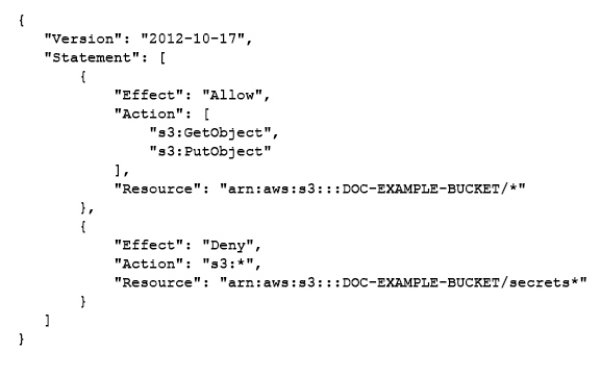
A developer has written the following IAM policy to provide access to an Amazon S3 bucket:

Which access does the policy allow regarding the s3:GetObject and s3:PutObject actions?

Select an option, then click Submit answer.

  • Access on all buckets except the “DOC-EXAMPLE-BUCKET” bucket

  • Access on all buckets that start with “DOC-EXAMPLE-BUCKET” except the “DOC-EXAMPLE-BUCKET/secrets” bucket

  • Access on all objects in the “DOC-EXAMPLE-BUCKET” bucket along with access to all S3 actions for objects in the “DOC-EXAMPLE-BUCKET” bucket that start with “secrets”

  • Access on all objects in the “DOC-EXAMPLE-BUCKET” bucket except on objects that start with “secrets”