4A0-107 Alcatel-Lucent Quality of Service

Loading demo links...

Showing 13–15 of 15 questions

Question 13

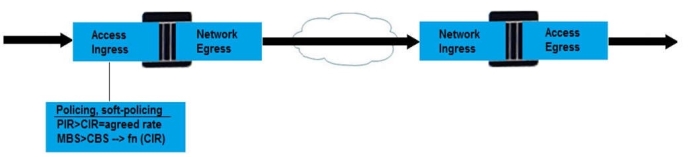
In the diagram shown above, applying policing and soft-policing on access ingress is typical for which of the following types of traffic?

Select an option, then click Submit answer.

  • Real-time

  • Assured

  • Best-effort

  • Self-generated

Question 14

How does a shaper rate-limit a traffic stream?

Select an option, then click Submit answer.

  • Packets that arrive in a burst are immediately dropped; packets that arrive with the proper in between space are immediately.

  • Packets are buffered on arrival and are forwarded at an average rate conforming with PIR, typically, with a reduced burstiness.

  • Packets with an average arrival rate higher than PIR are immediately dropped; conforming packets are forwarded at the same rate at which they arrive.

  • Packets with an average arrival rate higher than PIR are buffered for future processing; conforming packets are immediately forwarded.

Question 15

Which of the following is an example of something that CAN be done with hierarchical policing (CFHP) but CANNOT be done with standalone policers?

Select an option, then click Submit answer.

  • Limiting the maximum forwarding rate of each individual policer and, at the same time, marking, packets as in-profile or out-of-profile.

  • Putting packets in a buffer as they are received, and marking packets as in-profile or out-ofprofile as they are removed from the buffer.

  • Rate-limiting the collective output of several policers, and to reallocate bandwidth that is not utilized by some policers to other policers that need to use it.

  • Rate-limiting the collective output of several policers towards each egress FFPC, while maintaining control of the maximum overall forwarding rate.