
PMP in Two Months: A Realistic Study Plan
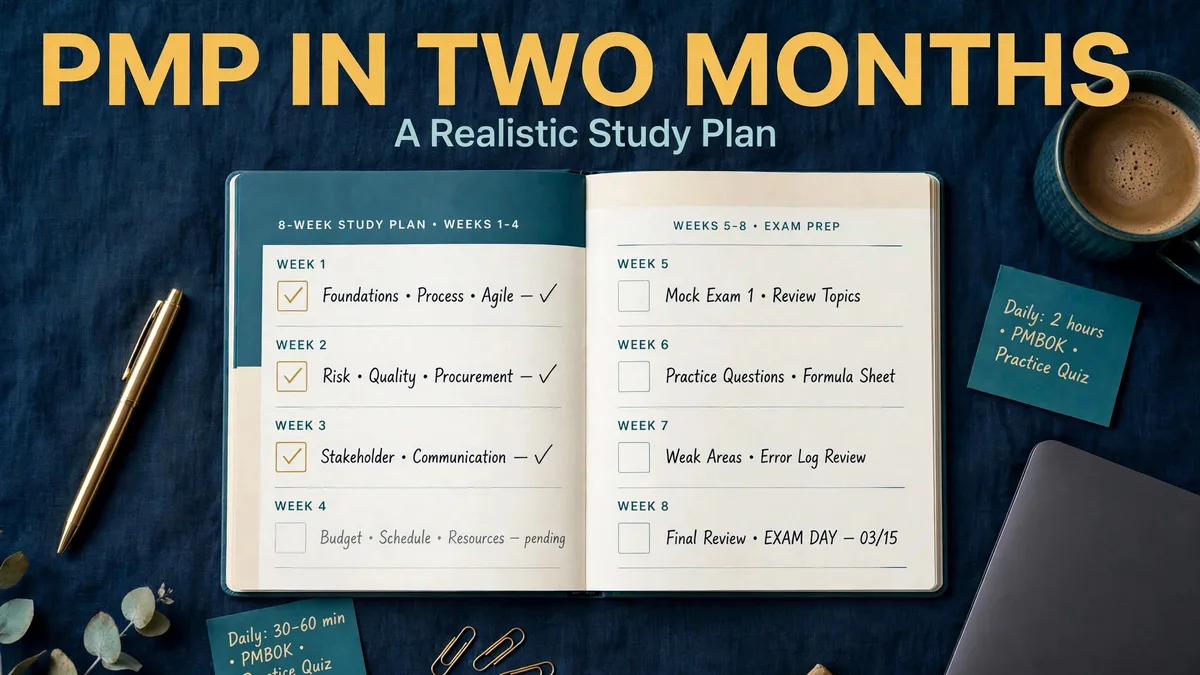
PMP in Two Months: A Realistic Study Plan
Two months is enough time to pass the PMP — if you already meet PMI's experience requirement and you treat the eight weeks like a project, with a scope, a schedule, and no gold-plating. It is not enough time to read everything ever written about project management, and it does not need to be. The current PMP exam tests 26 tasks across three domains, and a focused plan that follows those weights, practises under real timing, and fixes weak areas deliberately will get a working project manager from application to a pass in about 120 to 150 hours of study. This is that plan, week by week, built on the exam PMI actually launched in July 2026 — not the older version most guides still describe.
The PMP Exam You Are Actually Taking in 2026
PMP Domain Weights After the July 2026 Change
PMI replaced the PMP exam on 9 July 2026, and the changes matter for how you study. The three domains kept their names but not their weights: People is now 33% (was 42%), Process is 41% (was 50%), and Business Environment jumped from 8% to 26%. That last shift is the big one — governance, compliance, change control, risk, and organizational change now carry more than a quarter of the exam, and tasks that used to sit inside Process moved there. A study plan built on the old weights will under-prepare you for exactly the domain that grew.
PMP Exam Format: 180 Questions in 240 Minutes
The format changed with it. The exam is 180 questions in 240 minutes (up from 230), of which 170 are scored and 10 are unscored pretest questions you cannot identify. You get two 10-minute breaks.
PMP Question Types: Case Sets, Matching, and Graphics
Alongside multiple-choice questions there are now case and scenario sets — a short project situation followed by several linked questions — plus enhanced matching and graphic-based items. Roughly 40% of the exam reflects predictive approaches; the rest is agile and hybrid, spread across all three domains rather than quarantined in one section. PMI does not publish a passing score or a pass rate: your result is pass or fail, with a proficiency rating (Above Target, Target, Below Target, Needs Improvement) for each domain.
PMP Fees and the December 2026 Training Rule
Two administrative changes belong in your plan too. PMI raised the exam fee on 6 August 2026, to $425 for PMI members and $675 for non-members — the $250 gap is more than a year of membership costs, so joining before you register is the cheaper route for almost everyone. And from 1 December 2026, the 35 hours of training you need for eligibility must come from a PMI Authorized Training Partner, an accredited program, or self-paced study if it is delivered live by an instructor; an active CAPM also satisfies the training requirement.
PMP Eligibility: The Week-Zero Checklist
PMP Experience Routes: 36 or 60 Months
Do not start the eight-week clock until your application is submitted — approval is the real start line, and a random PMI audit can add days you did not budget. You qualify through one of two education routes: a bachelor's degree (or global equivalent) plus 36 months of project-leading experience, or a secondary diploma plus 60 months. The experience must fall within the last ten years, must not overlap between projects, and is listed project by project. Both routes require the 35 contact hours of project management training described above.
PMP Week Zero: Apply, Then Book the Exam Date
Week zero, then: confirm your months honestly, finish or schedule your 35 hours, submit the application, and — the move that makes the whole plan real — book your exam date for the end of week eight as soon as PMI approves you. You have one year of eligibility and up to three attempts in it, but the plan works because the date is fixed. A floating "when I'm ready" target is how two months quietly becomes six.
The PMP Two-Month Plan at a Glance
| Weeks | Focus | Main output |
|---|---|---|
| 1–2 | Process domain (41%) — the mechanics | Full first pass over planning, scope, schedule, cost, quality, procurement |
| 3–4 | People domain (33%) + the PMI mindset | Scenario judgement: leadership, conflict, stakeholders, communication |
| 5–6 | Business Environment (26%) + integration | Governance, risk, change, compliance; first full mock exam |
| 7 | Timed practice and weak-area repair | Two more full mocks; error log burned down |
| 8 | Final simulation and taper | One last mock early in the week; light review; exam day |
PMP Weekly Rhythm: Learn, Then Practise the Same Day
The rhythm inside every week is the same: learn a slice of content, then answer questions on it the same day. Reading without questions is how candidates reach week seven knowing the material and failing the scenarios — the exam tests what a project manager does next, in a situation, not what they can recite.
PMP Weeks 1–2: Process Domain — The Mechanics of Delivery
PMP Process Tasks in Project Order
Process is still the largest domain at 41%, so it gets the first two weeks while your energy is highest. Its ten tasks run the life of a project: developing the integrated plan and choosing the delivery approach, scope, value-based delivery, resources, procurement, finance, quality, schedule, evaluating status, and closure. Work through them in project order rather than alphabetically — plan, then scope and schedule, then cost and the earned value basics (CPI, SPI, and what a variance actually asks you to do), then quality, resources, and procurement, finishing with how status is evaluated and a project is closed.
PMP Process Study Habits to Build from Day One
Two habits to build from day one.
PMP Process Habit 1: Learn the Decision, Not the Definition
First, for every concept, learn the decision it drives: a risk register is not a definition to memorise, it is the thing you update before you escalate, and exam questions will ask which happens first.
PMP Process Habit 2: Study Predictive and Agile Together
Second, split your Process study evenly between predictive and agile delivery of the same work — how scope is controlled on a waterfall project versus how a backlog absorbs change — because the exam mixes both inside single scenarios. End week two with a 60-question timed set drawn only from Process; your score there is the baseline the rest of the plan repairs against.
PMP Weeks 3–4: People Domain and the PMI Mindset
PMP People Tasks: Servant Leadership in Eight Tasks
People (33%, eight tasks) is where experienced managers lose marks they expected to win, because the exam grades your judgement against PMI's model, not against what worked at your last company. The tasks: developing a common vision, managing conflict, leading the team, engaging stakeholders, aligning and managing stakeholder expectations, knowledge transfer, and planning and managing communication. The through-line is servant leadership — the project manager removes impediments, coaches, and escalates last; the team and the stakeholders do the work and own the decisions wherever the situation allows.
PMP Judgement Patterns to Install in Weeks 3–4
Learn the recurring judgement patterns explicitly.
PMP Mindset Rule: Coach Before You Escalate
When a team member underperforms, coach and support before you replace or escalate. When stakeholders disagree, bring them together and facilitate rather than deciding over them. When conflict surfaces, address it directly and collaboratively — PMI consistently prefers the problem-solving approach over forcing, smoothing, or avoiding.
PMP Change Requests: Through Change Control, Whoever Asks
When a sponsor asks for a change, it goes through change control, however senior the sponsor is. These patterns are sometimes called the "PMI mindset," and weeks three and four are where you install it: short daily scenario sets, and for every wrong answer, write down the principle you violated, not just the fact you missed. That error log becomes your week-seven repair list.
PMP Weeks 5–6: Business Environment — The Domain That Tripled
PMP Business Environment Tasks: Governance, Risk, and Change
Business Environment is the domain outdated plans will fail you on. At 26% — up from 8% — its eight tasks now include project governance, compliance, managing and controlling changes, removing impediments and managing issues, planning and managing risk, continuous improvement, supporting organizational change, and evaluating changes in the external business environment. Risk and change control moving here is precisely why this domain can no longer be treated as a light final chapter: questions that look like Process questions are now scored in Business Environment, and there are three times as many of them as before.
PMP Business Environment as the Layer Above the Project
Study it as the layer above the project: how the project is authorised and overseen, how it stays compliant with regulation and organisational policy, how benefits are tracked after delivery, and how external shifts — a new law, a market change, a reorganisation — feed back into project decisions. The July 2026 outline also weaves in current practice themes such as AI in project work and sustainability, so do not rely on pre-2026 materials that omit them.
PMP First Full Mock Exam at the End of Week Six
Close week six with your first full mock exam: all 180 questions, 240 minutes, breaks taken where the real exam offers them. Sit it in one session, at the same time of day as your booked exam if you can.
PMP Weeks 7–8: Mock Exams, Repair, and the Taper
PMP Mock Review: Sorting Errors by Cause
The last two weeks convert knowledge into a result. Take a full mock at the start of week seven and another mid-week, and review each one the same way: sort every wrong or guessed answer by domain and by cause. Knowledge gaps go back to the content for a focused hour.
PMP Judgement Errors: When the Workplace Answer Is Wrong
Judgement errors — where you knew the facts but picked what your workplace would do instead of what PMI's model prescribes — go into the mindset list from weeks three and four, and get drilled with scenario questions only.
PMP Timing Errors: Fix Them with Pacing
Timing errors, where you simply ran long, get fixed with pacing, below. A healthy trajectory is a mock score climbing steadily across the three simulations; what matters is the trend and the shrinking error log, not any single number, since PMI publishes no passing score to aim at.
PMP Exam Pacing: Three Blocks of 60 Questions
Pacing deserves its own drill because 240 minutes feels generous until it isn't. The exam naturally breaks into three blocks of 60 questions separated by the two breaks. Budget roughly 75 minutes per block, which leaves a small reserve, and take both breaks even if you feel fine — the clock pauses, your concentration resets, and questions 61 and 121 are worth exactly as much as question 1. Never leave a question blank: flag the ones you are unsure of, answer everything, and use leftover minutes on the flagged set only.
PMP Week Eight Taper: Light Review, No New Material
In week eight, take your final mock early — Monday or Tuesday — then taper. Light review of your error log and the domain task lists, no new material, normal sleep. Cramming new content in the last 48 hours trades confidence for coverage you will not retain, and the exam rewards judgement under mild pressure far more than last-minute facts.
A PMP Study Week, Hour by Hour
PMP Weekday Study: Two Focused Hours a Day
The plan assumes a working professional's week, because that is who takes this exam. Weekdays: two focused hours — one before or after work for content, one for questions on that same content. Weekends: one longer block of three to four hours for a timed set or a mock, plus an hour reviewing it. That is roughly 15 to 17 hours a week, 120 to 140 hours across the plan.
PMP Study Hours: Protect Practice First
If your weeks are smaller, protect the question practice first and trim reading — the ratio matters more than the total. If you have leave to spend, spend it in week seven, not week one: timed practice under fatigue is where extra hours pay off most.
PMP Exam Day: What 240 Minutes Feels Like
PMP Exam Day Format: Centres, ID, and the First 60 Questions
You can sit the PMP at a Pearson VUE test centre or online with a proctor; choose the centre if your home setup or internet is unreliable, because an online session that drops is your problem, not PMI's. Arrive with the ID exactly matching your application name. The first 60 questions set your rhythm — expect long scenario stems, case sets that share one situation across several questions, and a handful of matching or graphic items. Answer, flag sparingly, keep the block budget.
PMP Exam Breaks: Leave the Screen
On the breaks, actually leave the screen: water, movement, no phone-checking of half-remembered answers.
PMP Results: Immediate, With a Per-Domain Profile
Your result appears immediately at a test centre; either way, the per-domain proficiency profile that follows is the useful document — Above Target across the board is a pass with margin, and a single Below Target domain alongside a pass is common and changes nothing about the credential.
If Your PMP Mock Scores Stall
PMP Mock Plateau: Reading the Diagnosis
A plateau in weeks six or seven is diagnostic, not fatal — but only if you read it correctly.
PMP People Weakness: A Mindset Problem
If your Process answers are strong and People answers are weak, you do not have a knowledge problem, you have a mindset problem: reread the judgement patterns and drill scenarios until "support the team, facilitate, follow the process" becomes your default under time pressure.
PMP Business Environment Weakness: Check the Outline Date
If Business Environment is the weak domain, the usual cause is studying from pre-2026 materials — check the outline date on everything you use, because the old 8% version of that domain no longer exists.
PMP Flat Scores and Timing Failures
If all three domains are flat, the honest fix is volume of reviewed questions: not more reading, more questions with every wrong answer explained back to the task it belongs to. And if timing is the failure, it is almost always the first block — candidates linger early, then rush the questions that decide the result.
What the PMP Costs on the Two-Month Route
PMP Cost Table: Membership, Fees, Training, Renewal
| Item | Cost |
|---|---|
| PMI membership (optional, one year) | Roughly $160, plus a small one-time joining fee |
| Exam fee — PMI member | $425 |
| Exam fee — non-member | $675 |
| 35-hour training course | Varies — self-paced online is the cheapest eligible route |
| Renewal, every three years | 60 PDUs plus $60 (member) or $150 (non-member) |
PMP Salary Premium: The Return on the Fee
The return side of the ledger is why the exam survives every fee increase: PMI's Earning Power salary survey puts the US median for PMP holders at $135,000, and PMI reports holders earning more on average than non-certified peers in most countries surveyed. Treat any single salary figure cautiously — it varies sharply by country and industry — but the direction of the premium is one of the most consistent findings in the profession's salary data.
PMP Two-Month Study Plan: FAQ
Can you really pass the PMP in two months?
Yes, if you already meet the experience requirement and can protect roughly 15 hours a week. Two months fails when it is spent reading cover to cover; it works when the time follows the domain weights — 41% Process, 33% People, 26% Business Environment — and at least a third of it is timed question practice with reviewed answers.
How many hours a day should I study for the PMP?
Two focused hours on weekdays and a longer block on weekends is the sustainable version of this plan. More than three hours a day of new content usually degrades retention; if you have extra time, spend it on practice questions and error-log review rather than additional reading.
Which PMP domain should I study first?
Process, because it is the largest at 41% and its mechanics underpin the scenarios in the other two domains. But do not use an old study order that leaves Business Environment for a final skim — at 26% since July 2026, it needs a full two weeks of its own.
Is the PMBOK Guide enough to pass the PMP?
No. PMI states the exam is built from the Exam Content Outline, not from any single book, and the current outline spans predictive, agile, and hybrid practice well beyond one guide. Use the PMBOK Guide (now in its eighth edition) as a reference, study to the outline's 26 tasks, and measure yourself with timed practice questions.
What if I fail the PMP on my first attempt?
Your one-year eligibility window allows up to three attempts, and the per-domain proficiency profile from your first attempt tells you exactly where the repair work is. Most retake plans are shorter than the original: two to four weeks aimed at the weak domain, then another sitting while the rest is still fresh.
However you structure your eight weeks, the measuring instrument is the same: timed, exam-style questions, reviewed properly. Study4Pass is the 1st AI-Enabled exam practice — its free PMP practice test gives you 570 questions and answers to work through by domain, and the free 20-question PMP demo is the quickest way to check your starting point today, before week one begins. Ask AI sits under every question and explains the concept behind it through your own ChatGPT, Gemini, Claude, or Copilot account — which is exactly the review habit this plan is built on.