
PenTest+ (PT0-003): The Hands-On Pentesting Exam
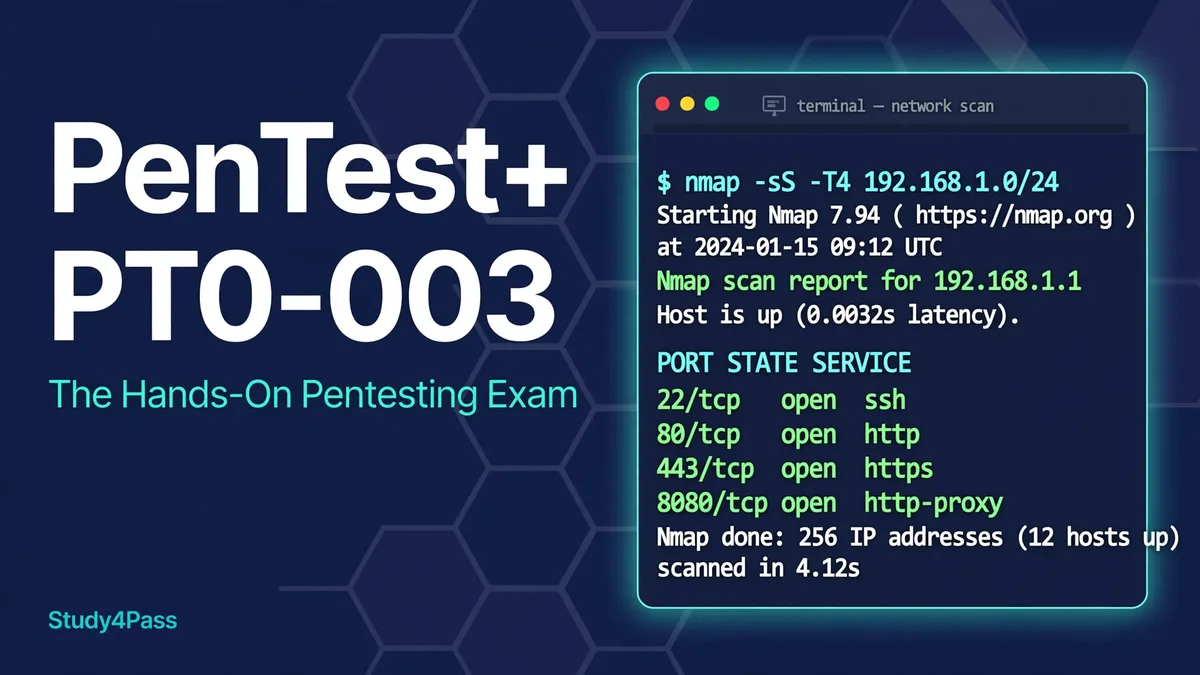
PenTest+ (PT0-003): The Hands-On Pentesting Exam
Most certification exams ask you what you know. PenTest+ asks you what you can do. That is the whole difference, and it is the reason this exam catches out candidates who arrive with a head full of definitions and no hours in a lab. The current version, PT0-003, launched on 17 December 2024 and replaced PT0-002, which CompTIA has retired. It is a practitioner-level exam: the questions describe situations a penetration tester actually meets — a scope document with a hole in it, a scan result that might be a false positive, a foothold that needs turning into lateral movement — and ask what you would do next. If you have done the work in a lab, the exam reads like a working day. If you have only read about the work, it reads like a trick.
The Exam You Are Actually Taking
PenTest+ sits in the middle of CompTIA's security ladder. It is not an entry exam, and it is not an expert exam. CompTIA positions it for security professionals who already hold Network+ and Security+ level knowledge and have hands-on penetration testing experience. There are no formal prerequisites — you do not need another certification or a degree to book it — but the exam assumes that background, and candidates who arrive without it feel the gap in the first twenty minutes.
PenTest+ PT0-003 exam facts
The exam is a maximum of 90 questions, taken in 165 minutes, and it mixes multiple-choice questions (single and multiple response) with performance-based questions — short simulations of real tasks that appear mostly at the start of the exam. The pass mark is 750 on a scale of 100 to 900. That is a scaled score, not a percentage of questions answered correctly, so do not try to convert it into a number of questions you must get right; there is also no per-domain cutoff, and a single overall score decides the result. Your score report still breaks performance down by domain, so if you need a retake you can see exactly where to restudy. You book and sit through Pearson VUE, at a test centre or from home with OnVUE online proctoring. The voucher price is the one figure to confirm at booking: CompTIA raised its voucher prices on 1 June 2026, and the pre-increase PenTest+ list price was $404. The certification is valid for three years and can be renewed through CompTIA's Continuing Education programme. No retirement date has been announced for PT0-003 — it is the current version.
Who should take it, and who should wait
The right candidate has already done the foundational work. You can read a scan report and tell a real finding from a false positive. You have run Nmap against a target you owned, enumerated services, and followed up on what you found instead of stopping at the scan output. You know what a rules-of-engagement document is for, and you have at least read one. If that describes you, PenTest+ is the credential that turns hands-on experience into something an employer can verify.
If you have not yet passed Security+ or done equivalent study, wait. PenTest+ assumes the Security+ vocabulary — authentication, cryptography, network services, common vulnerabilities — and spends its questions on applying it, not teaching it. Candidates who skip that step usually discover the gap in the Attacks and Exploits domain, which is more than a third of the exam, and by then the clock is already running.
Retakes, and what a fail costs you
A failed attempt is not the end of the plan, but it is not free either. Retakes are paid again, at the same voucher price. CompTIA's retake policy allows an immediate retake after a first fail, then imposes a 14-day waiting period after a second fail — so the sensible approach is to treat the first attempt as the real one and use the score report, not a second sitting, as the study guide. Book only when timed practice sets are consistently landing above the pass line, not when you merely feel ready.
The Five Domains, in Weight Order
CompTIA organises PT0-003 into five weighted domains, and the weights are the study plan. Attacks and Exploits alone is 35% of the exam — more than Engagement Management and Vulnerability Discovery combined — so preparation time should follow the published weights, not your comfort zone.
Attacks and Exploits — 35%
This is the domain the exam is named for, and it is where reading without doing is punished hardest. It covers network attacks such as VLAN hopping, on-path attacks and service exploitation; authentication attacks including brute force, pass-the-hash and credential stuffing; host-based attacks such as privilege escalation, process injection and credential dumping; web application attacks including SQL injection, cross-site scripting and directory traversal; and cloud attacks such as container escapes, metadata service attacks and identity and access management misconfiguration. The newest addition is AI attacks: explaining prompt injection and model manipulation against artificial intelligence systems. Study this domain in a lab, not in a book. For each attack type, know the technique, the tool that performs it, the evidence it leaves, and the fix — because the exam asks about all four, and the performance-based questions ask you to perform the first two.
The trap in this domain
Candidates who memorise attack names without practising them answer the definition questions and fail the scenario ones. A question that describes a web application returning a database error is not asking you to name SQL injection. It is asking what you do next, and in what order, and what you report. Practise the sequence, not the vocabulary.
Reconnaissance and Enumeration — 21%
The second-heaviest domain, and the one that rewards patience. It covers active and passive reconnaissance — gathering information with open-source intelligence, network sniffing and protocol scanning — and enumeration techniques including DNS enumeration, service discovery and directory enumeration. The tools CompTIA names here are the ones to know properly: Nmap, Wireshark and Shodan. It also covers modifying Python, PowerShell and Bash scripts for reconnaissance and enumeration, which is a different skill from writing scripts from scratch: the exam expects you to read a script, spot what it does, and change it to fit the target. Spend real time with Nmap's output formats and with DNS enumeration, because both appear in scenario questions where the answer depends on reading output correctly rather than recalling a flag.
The trap in this domain
Reconnaissance questions punish candidates who jump to exploitation. The exam repeatedly tests whether you enumerate thoroughly before you attack, and whether you can tell the difference between information you gathered passively and information that required touching the target. That distinction matters legally as well as technically, and it is tested.
Vulnerability Discovery and Analysis — 17%
This domain is the bridge between finding things and attacking them. It covers vulnerability scans — authenticated and unauthenticated, static application security testing and dynamic application security testing — and, more importantly, result analysis: validating findings, troubleshooting scan configurations, and identifying false positives. The tools named are Nessus, Nikto and OpenVAS. The skill the exam actually measures here is judgement. A scanner will hand you a long list of findings; a penetration tester has to decide which ones are real, which ones matter, and which ones are artefacts of the scan itself. Practise by running a scan against a lab target, then manually verifying three findings — one real, one false positive, one misconfiguration — and writing down how you proved each one.
Engagement Management — 13%
The lightest domain by weight and the easiest to underestimate, which is exactly why it costs candidates points. It covers planning and scoping — defining rules of engagement, testing windows and target selection — legal and ethical compliance, including authorisation letters and mandatory reporting, collaboration and communication with stakeholders through peer reviews, escalation paths and risk articulation, and penetration test reports: executive summaries, findings and remediation recommendations. This is the domain that separates a tester from a hobbyist. Know what must be in writing before testing starts, what you do when you find something outside the agreed scope, and how a finding is written so that a non-technical executive can act on it. The report-writing questions are straightforward marks for candidates who have ever written a real report, and lost marks for everyone else.
Post-exploitation and Lateral Movement — 14%
The final domain covers what happens after the first foothold: establishing persistence, performing lateral movement, and cleaning up artefacts, plus documentation — creating attack narratives and providing remediation recommendations. It is the smallest domain after Engagement Management, but it is the one that most closely resembles real penetration testing work, where getting in is the beginning of the engagement rather than the end of it. Study it alongside Attacks and Exploits rather than separately: a privilege escalation question and a lateral movement question are often two halves of the same scenario.
What Changed From PT0-002
PT0-003 is version 3 of PenTest+, launched on 17 December 2024. The domains were restructured for this version: Attacks and Exploits now carries 35% of the exam, and the syllabus adds cloud attacks — container escapes, metadata services, identity misconfiguration — and AI attacks, prompt injection and model manipulation, which did not exist as exam topics in the previous version. If you studied for PT0-002, do not assume your notes transfer cleanly. The core skills are the same, but the weight has shifted towards exploitation and towards cloud and AI surfaces, and the performance-based questions reflect the new syllabus. If you hold PT0-002 study material, use it for fundamentals and re-learn the domain weights and the new topics from the current objectives.
The 50-question bank, stated plainly
Our PT0-003 practice set currently holds 50 questions — a starter bank carried over from the PT0-002 practice set, the exam PT0-003 succeeds — so you can begin drilling the subject matter now while the full PT0-003 bank is built out. Ten questions are free in the web test engine, with an answer and a full explanation for every question, and every question carries the Ask AI panel. Treat the starter bank as a diagnostic and a drill set, not as the whole exam: it covers the domains, but the full bank is what will carry the new cloud and AI topics in depth.
A Six-Week Study Plan That Actually Works
Six weeks is a realistic window for a candidate who already holds Security+ level knowledge and can study an hour or two a day, with longer sessions at the weekend. If you are starting without that background, add two weeks at the front for Security+ revision and do not compress the plan below.
Week 1 — Scope, rules and recon
Read the current exam objectives end to end, then study Engagement Management properly: rules of engagement, authorisation, scope, reporting. Set up the lab at the same time — a virtual machine you own, a target you are allowed to attack, and Nmap installed. End the week by running a full Nmap scan against the lab target and writing down every open service and what it might mean. That single exercise covers two domains at once.
Week 2 — Reconnaissance and enumeration
Work through active and passive recon in order: OSINT first, then DNS enumeration, then service and directory enumeration. Practise reading Nmap and Wireshark output until you can explain a capture in plain words. Modify a short Python or Bash script to change what it enumerates — the exam tests script modification, so reading and editing code matters more than writing it from a blank page.
Week 3 — Vulnerability discovery
Run authenticated and unauthenticated scans against the lab target with Nessus or OpenVAS, then validate the findings by hand. Pick three findings and prove each one: one real vulnerability, one false positive, one configuration issue that is not a vulnerability at all. Write each one up as a short finding with severity and remediation, because that is the report-writing skill the exam tests in Engagement Management as well.
Week 4 — Attacks and Exploits, part one
The heaviest domain gets two weeks. Start with network and authentication attacks: brute force, pass-the-hash, credential stuffing, service exploitation. Practise each one in the lab, and for each one write down the evidence it leaves and the fix. Do timed sets at the end of the week — 30 questions in 50 minutes — and review every miss with the explanation, not just the correct letter.
Week 5 — Attacks and Exploits, part two
Web application attacks, host-based attacks, cloud attacks and AI attacks. SQL injection, cross-site scripting and directory traversal in the lab; privilege escalation and credential dumping on the host; container escapes and metadata service attacks in the cloud; prompt injection and model manipulation as concepts you can explain, with an example of each. Finish the week with a full timed mock: 90 questions in 165 minutes, including the performance-based questions first, exactly as the real exam presents them.
Week 6 — Post-exploitation, mocks and exam day
Persistence, lateral movement and cleanup, then two more full mocks on separate days, with a rest day between them. Use the score reports to find the weakest domain and drill only that domain on the final day. The day before the exam, stop studying at midday: check your ID, confirm the test centre or OnVUE setup, and sleep. Cramming the night before a hands-on exam does not work, because the exam tests judgement under time pressure, and tired judgement is the first thing to go.
The daily rhythm that makes the plan stick
Every study day has the same shape: thirty minutes of reading, thirty minutes in the lab, thirty timed questions, then ten minutes reviewing every miss. Reading without lab work does not transfer to this exam, and lab work without timed questions does not transfer to the clock. The review step is the one most candidates skip and the one that matters most — a miss you understand is worth more than ten questions you already knew.
Exam Day: 165 Minutes, 90 Questions, No Panic
The performance-based questions come mostly at the start, so expect the first part of the exam to feel slow. That is normal: a simulation takes longer than a multiple-choice question, and the clock allows for it. Do not rush the first section to bank time; the time you save by guessing a simulation is worth less than the marks you lose by getting it wrong. Work through the performance questions carefully, flag anything you are unsure about, and move on — you can return to flagged questions at the end if time allows.
Pacing that works
Ninety questions in 165 minutes is about one minute and fifty seconds per question on average, but the average misleads: simulations take several minutes each and straightforward multiple-choice questions take less than a minute. Plan on finishing the multiple-choice questions with fifteen minutes to spare, and use that time on flagged items rather than on re-reading questions you already answered confidently. If a question has defeated you after two minutes, flag it and move on — the exam has no per-domain cutoff, so a single hard question is never worth sacrificing three easy ones for.
The traps to watch for
Three traps recur. First, scope: a question that describes a target outside the agreed rules of engagement is testing whether you stop, not whether you can exploit it. Second, false positives: a scan result is not a finding until it has been validated, and the exam will offer you an unvalidated result as an answer. Third, reporting: a technically correct finding written for the wrong audience is the wrong answer. When two answers both look technically right, pick the one that follows the engagement rules, validates the finding, or communicates it properly — that is usually the one the exam wants.
Where PenTest+ Leads
PenTest+ is a practitioner credential, and its value is in the jobs it opens rather than the letters after your name. The direct roles are penetration tester, vulnerability analyst and security consultant, and the credential also supports security engineer and SOC analyst roles where hands-on testing is part of the work. It sits alongside CySA+ rather than below it: PenTest+ tests offensive skills, CySA+ tests defensive analysis, and many security professionals hold both. The natural next steps after it are the advanced practical certifications — CASP+ for breadth at the advanced level, or a dedicated offensive credential such as OSCP for depth — but neither is urgent. The sensible sequence is to use PenTest+ to get into testing work, build a year of real engagements, and then let the work decide which advanced credential matters.
What employers actually check
Employers hiring for penetration testing roles ask about PenTest+ because it signals that a candidate can do the work, not just describe it. That is also why the exam itself is hands-on: a credential that only tested definitions would not tell an employer anything useful. When you interview, expect to talk through the lab work the same way the exam tests it — what you found, how you validated it, what you recommended, and what you would do differently. The exam is good preparation for that conversation, because it is the same conversation in question form.
Start With the Free Demo
The fastest way to judge whether you are ready for PT0-003 is to try the questions. The free demo is ten questions drawn from the full 50-question bank, with an answer and a full explanation for every question and the Ask AI panel on each one, so you can understand the concept behind anything you miss. If the demo feels like work you have already done, you are closer than you think. If it feels unfamiliar, the six-week plan above is the way in — and the domains, in the order the exam weights them, are where to start.
Try the free PT0-003 practice test at Study4Pass — the free PT0-003 practice test with 50 questions and answers — and start with the 10-question free demo first to calibrate, no signup, with an explanation and the Ask AI panel on every question, and free updates for 90 days when you are ready for the whole set.