Books Teach. Timed Practice Makes You Pass.
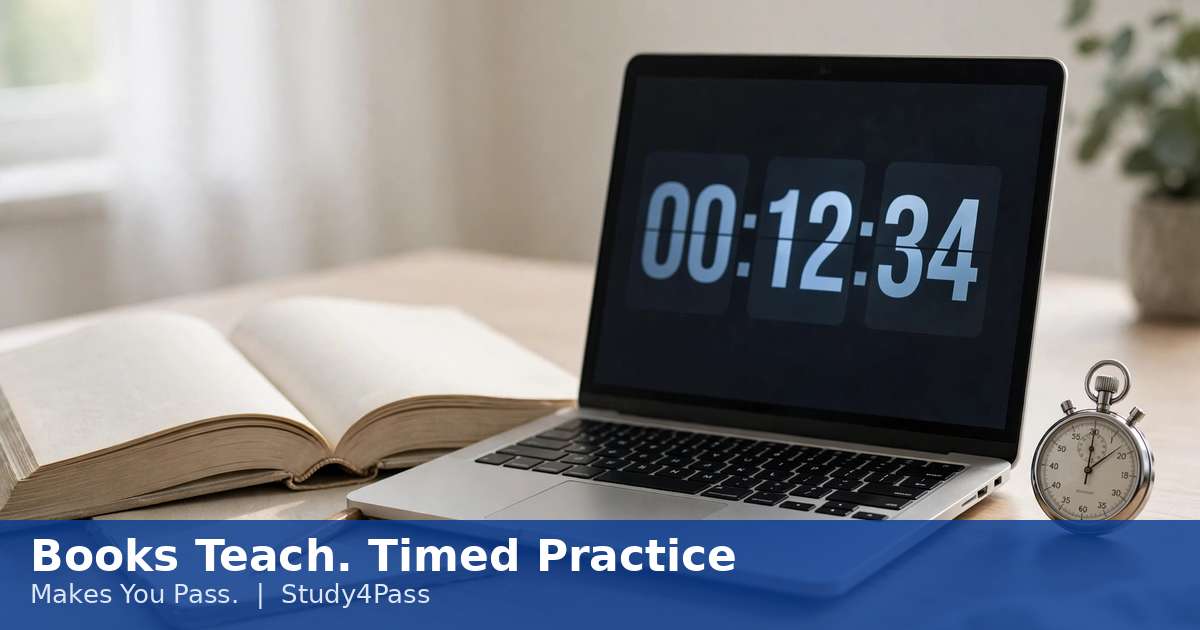
Books Teach You the Material. Timed Practice Is What Makes You Pass.
Read the book, fail the exam. It happens constantly, and it confuses people because they did the work. They read the chapters. They highlighted things. They could explain the concepts out loud. Then they sat down, the clock started, and everything felt different.
That is not bad luck. It is two different skills being mistaken for one.
The Book Gives You Knowledge. The Exam Wants Judgment.
A book teaches one concept at a time, in order, with the answer sitting right there on the page. You read about OSPF, then you read about ACLs, then you read about NAT. Clean. Logical. Nothing like the exam.
The exam throws all of it at you at once, wrapped inside a scenario. A user cannot reach an application. A policy is blocking something it should not. A project is slipping and the sponsor is asking questions. Then it gives you four answers that all sound reasonable, and the difference between the right one and the wrong one is a single word: first, most, least, best.
Here is a concrete example. A book teaches you five reasons an OSPF adjacency can fail: mismatched hello timers, mismatched area IDs, an MTU mismatch, an authentication mismatch, a subnet mismatch. You can memorize that list in an afternoon. The exam shows you router output and asks which one is actually broken here, in this topology, with the clock running. If you have never practiced reading output under pressure, the list does not save you.
Security+ works the same way. The book teaches you what a firewall rule does, what a log entry means, how incident response phases fit together. The exam gives you a performance-based question: logs, a half-configured firewall, a ticking clock, and a prompt asking you to put the response steps in the right order. Knowing the phases and doing them under pressure are not the same thing.
Books teach you what things are. Exams ask you what to do when three things break at once.
The Three Traps Book-Only Learners Fall Into
Trap 1: Mistaking recognition for recall.
When you read a chapter, the answer is on the page, so everything feels familiar. That familiarity lies to you. Recognition — "I have seen this before" — is much weaker than recall — "I can produce this from memory under pressure." The exam tests recall. The only way to find out whether you actually know something is to answer questions about it without the book open.
Trap 2: Studying everything equally.
A book gives every chapter roughly equal weight. The exam does not. Some domains carry far more questions than others, and your personal weak spots are not evenly spread. Book-only learners re-read the whole book a second time and call it revision. It is not revision. It is comfort. Revision is fixing the two domains that are costing you points, and you only find those by testing.
Trap 3: Never meeting the clock.
Reading has no time limit. The exam is entirely time-limited. Candidates who never practice under a clock spend three minutes on an early question, panic halfway through, and rush the last twenty. They do not fail because they did not know the material. They fail because they ran out of time while knowing it.
What Timed Practice Actually Trains
A timed, exam-style practice test is a dress rehearsal. It trains four things no book can.
The clock.
Most certification exams give you somewhere around a minute per question. That is not much time to read a scenario, eliminate two wrong answers, and choose between the two that remain. Timed sets teach you pacing: flag the hard ones, answer the ones you know, come back with a clear head. You learn your own rhythm before the exam, not during it.
The wording.
Exam questions are written precisely, and small words change the answer. "What should you do first?" is a different question from "What should you do?" A question that asks for the best answer is telling you more than one option is defensible — you have to pick the one that fits the scenario's constraints. Practice with exam-style questions trains you to read what is actually being asked instead of what you expected to be asked.
Your weak spots.
A practice test with instant feedback tells you exactly which domains are costing you points. That turns the last weeks of study from "re-read everything" into "fix these two domains." A book cannot score you. A practice test can, and that score is the most honest study plan you will ever get. If your identity and access scores are strong but your monitoring scores are weak, you now know exactly where your remaining hours go.
Your nerves.
Walking into the exam knowing you have already finished full-length timed sets changes how you perform. You are not hoping you are ready. You have evidence. That matters more than people admit — half of exam-day failure is panic, not knowledge. The first time you sit a timed test, the clock rattles you. The fifth time, it is background noise. That is the whole point of rehearsal.
What a Good Practice Test Looks Like
Not all practice material is equal. A good practice test has four qualities, and they are worth checking before you spend time on it.
1. The questions should read like exam questions: scenarios, not definitions. If every question is "What does X stand for?", it is a flashcard deck, not a practice test. Real exam questions ask you to decide something.
2. Every answer should come with an explanation — including the right ones. An explanation for a correct answer confirms why it is correct, which is what stops you from getting the same question wrong in a different form later.
3. It should break your score down by domain, so you can see where you are strong and where you are bleeding points. A single overall percentage tells you almost nothing. A domain breakdown tells you what to study tomorrow morning.
4. It should have a timed mode. Untimed practice has its place early on, when you are still learning. But at some point the clock has to come on, because the real exam has one.
How to Use Both
The strongest preparation is not books or practice tests. It is both, in this order.
1. Learn with the book.
Read one solid guide cover to cover. Take notes in your own words. Do the labs as you go. This is where real understanding is built, and there is no shortcut around it.
2. Test after every domain.
When you finish a section, take a timed practice test on that material — twenty or thirty exam-style questions, clock on. Review every wrong answer and learn why the right answer is right. Keep a running list of your misses. That list becomes your most valuable revision material.
3. Drill the weak spots.
Use your practice scores to find your two weakest domains and go back to the book for those sections only. Targeted re-reading beats re-reading everything.
4. Full dress rehearsal.
In the final week, take full-length timed practice tests under real conditions: one sitting, no breaks for research, no looking things up. Score yourself by domain, fix what is still weak, and rest before exam day.
How many practice tests should you take? Enough that the format stops surprising you. For most people that means several domain-level sets during study plus two or three full-length rehearsals before exam day. If your scores are still climbing, keep going. If they have plateaued, shift the time back to the book for your weakest domains.
What This Looks Like in a Real Study Week
Theory is easy. Here is what a working week actually looks like when books and practice tests are combined properly.
Monday and Tuesday: book chapters and labs for one domain. Read, take notes, build the thing. No questions yet — you are still learning.
Wednesday: thirty timed questions on that domain, clock on. Then the part most people skip: review every single miss. Do not just read the explanation. Close it, answer the question again from memory, and explain out loud why the right answer wins. If you cannot do that, you have not learned it yet — you have only recognized it.
Thursday and Friday: book chapters and labs for the next domain, then thirty timed questions on it, same review ritual.
Saturday: a mixed set across both domains, timed, full exam conditions. Score it by domain and write down your two weakest areas.
Sunday: light review of your misses list only. No new material. Rest. Your brain consolidates what you practiced, and you walk into the next week knowing exactly what to fix.
That is the whole system. Book, test, review, fix, repeat — until the practice scores say you are ready.
Find Out Where You Actually Stand
Stop guessing whether you are ready. Take a free practice test with exam-style questions and instant feedback — no signup, start now — and gauge your readiness in one sitting. You will see which domains are strong, which ones need work, and exactly what to study next. Walk in ready on exam day, and let your exam-day self thank you for the rehearsal.
